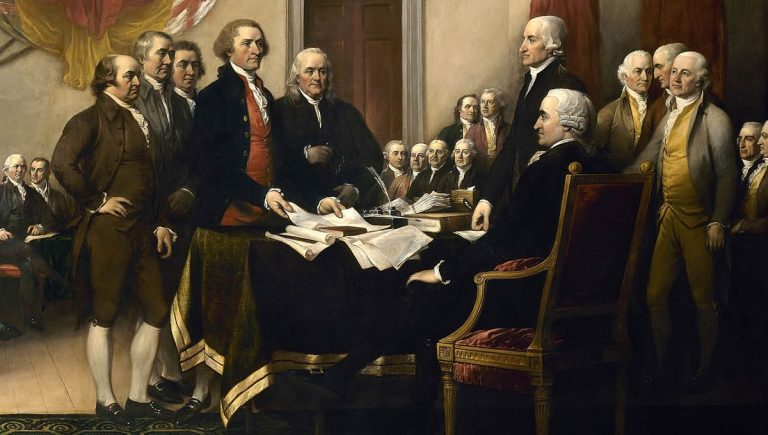
Which of the key founding fathers signed or worked on the Declaration of Independence and which worked on the Constitution?
THE DECLARATION OF INDEPENDENCE John Adams, Benjamin Franklin, Thomas Jefferson and John Hancock were signers of the Declaration of Independence . George Washington, James Madison, Alexander Hamilton and Benjamin Franklin were signers for the Constitution. Washington was serving as the Commander of the Continental Army in 1776 when the Declaration of Independence was being prepared, and was not present at the creation. The more youthful, Madison and Hamilton were not members of the Continental Congress at the time. The Declaration of Independence was prepared by the 2nd continental congress working in Philadelphia. John Hancock was the president of the body-which partly explains why he signed his name much larger then the others. The document itself was drafted by a committee made up of John Adams, Benjamin Franklin, Thomas Jefferson, Roger Sherman, and Robert Livingston. Thomas Jefferson, wrote the first draft of the Declaration of Independence and is often given credit for writing the document, but it was edited by the the committee , and then edited again by the whole Congress. Fifty-six members of Congress signed it.
THE CONSTITUTION and THE BILL OF RIGHTS The United States Constitution, a longer document, was written in Philadelphia during the summer of 1787, by the Philadelphia Convention , a body appointed for that purpose, to replace the Articles of Confederation -which were the United States' original ,unworkable founding documents. George Washington, presided over the body.
The original hand written Constitution.
The writing of the actual text of the Constitution was a group effort with much of the work done by two committees. One committee, the Committee of Detail did much of the initial writing. The members of that committee were Oliver Ellsworth of Connecticut, Nathaniel Gorham of Massachusetts, Edmund Randolph of Virginia, John Rutledge of South Carolina and James Wilson of Pennsylvania. A second committee, the Committee of Style Arrangement was responsible for the final draft. That committee included Alexander Hamilton of New York, William Samuel Johnson of Connecticut, Rufus King of Massachusetts, James Madison of Virginia, and Gouverneur Morris of Pennsylvania It is said that Gouvenour Morris is responsible for the phrase "we the people" . Hamilton, Madison and John Jay were responsible for the Federalist Papers a series of essays , that explained and defended the constitution. Madison later was the primary writer of the Bill of Rights, which were the first ten amendments to the constitution which were written in 1789. Because of Madison's key role -he is typically labeled as the father of constitution.
The original Bill of Rights
Why were Jefferson and Adams not involved in drafting the constitution? They were overseas serving as an ambassadors in 1787 during the Constitutional convention. Only six founders signed both documents:George Clymer, Benjamin Franklin, Robert Morris, George Read, James Wilson, and Roger Sherman. Thus Benjamin Franklin, was the the only well known founder found on US currency who was involved in both documents.
One of the drawbacks of being a member of a group with multiple songwriters is that sometimes there is not room on albums for all the songs you write. However, that means that is always going to be material to bring out of the drawer, when you are looking for material for a new project. Few artists have gone to that mythical song drawer as much as Stevie Nicks has. She has released over 40 of these drawer songs that she finished years after she wrote them. She even released a whole album of new versions of mostly old unreleased songs called 24 Karat Gold in 2014. The advantage of the later versions is that they are often more polished, the earlier demo versions benefit from having Stevie's younger, richer voice.
This list does not include Stevie Nicks songs recorded during album sessions (such as "Violet and Blue") that were released unaltered soon afterwards on soundtrack albums or B-sides, nor does it include unreleased songs that she has not gotten around to releasing or recording yet. (Note: As I am not a Stevie Nicks expert, this list may be incomplete)
BUCKINGHAM NICKS ERA (1969-1974)
"Cathouse Blues" was written in 1969 not recorded til 2014's 24 Karat Gold.
"Candlebright" (also known as "Nomad" ) The song was recorded by Nicks and Lindsey Buckingham in demo form, and was almost used on the 1975 Fleetwood Mac album Instead it was not used till 2001's Trouble in Shangri-La.
"I Don't Want to Know". Written during the Buckingham Nicks era, and performed live during that time. It was dragged up for Fleetwood Mac's 1977 Rumours album as a replacement for "Silver Springs", a better song which unfortunately was too long to fit on the album.
"Lady" (Also known as"Knocking On Doors") was written in the early 1970's and finally recorded on24 Karat Gold.
"Without You' -a Buckingham Nicks song that did not see release til it was recorded in a new version for the 2013 Fleetwood Mac digital EP, Extended Play. This record was the last recordings made by Stevie Nicks with Lindsey Buckingham.
"That's All Right " used on 1982's Fleetwood Mac album, Mirage. It was written in 1974 during the Buckingham-Nicks era, and intended for their never made second album.
"Crystal" Released on Buckingham Nicksbut recorded again for the 1975 Fleetwood Mac album, and recorded yet again by Stevie Nicks for the 1998 Practical Magic soundtrack album.
"Sorcerer" also dates back to the "Buckingham-Nicks" era and was recorded by them as a demo, as well as being performed on the subsequent tour. It was also considered for some Fleetwood Mac projects, in particular 1979's Tusk, it was given to Marilyn Martin to record in 1984 for the Streets of Fire soundtrack. It was also recorded for album "The Wild Heart"- and released as a bonus track for a 2016 reissue of that album. "Sorcerer" was finally was recorded and released by Stevie Nicks in an excellent version produced by Sheryl Crow for the 2001 Trouble in Shangri-Laalbum.
The original working tapes for "If You ever did Believe" and for "The Dealer" . Both of these not used and left off the Tusk album. Great stuff ....
EARLY FLEETWOOD MAC STINT (1974-1981)
"Think About It' written around 1974, considered for Rumours, but recorded for Bella Donna
"The Highwayman" written around 1975, but recorded for Bella Donna.
"Kind of Woman" written around 1975, recorded for Bella Donna.
"Leather and Lace" written in 1975 for (but not used by) Jessi Colter and Waylon Jennings, it of course, ended up on Bella Donna.
Leather and Lace (original demo)
"After the Glitter Fades" Said to be written in 1975, but finally used on 1981's Bella Donna.
"Planets of the Universe" was written during the Rumours period while Nicks and Buckingham were separating, which was Nicks' inspiration for the song. A rough demo (performed byFleetwood Mac) ended up on the remastered and expanded release of Rumoursin 2004. Nicks chose to include a edited version of the song on Trouble in Shangri-La, omitting a verse . The full-length 2001 version of this song, with the extra verse (as originally demo-ed on the expanded release of Rumours), did appear on a 6 track single release in late 2001.
"If You Ever Did You Believe" started as in 1976 as a coda to "The Chain" , it was first released as independent song given to Louise Goffin in 1981. It was finally used by Stevie Nicks in a version recorded with Sheryl Crow for the 1998 Practical Magic soundtrack album.
"Secret Love" wrote the song in 1976 and recorded a demo for Fleetwood Mac's 1977 album, Rumours, but was not finished and released until the In Your Dreams album in 2011.
"Silver Springs" was recorded for Rumours in 1977 and released as a B-side, but found commercial success in a new live version recorded for 1996 Fleetwood Mac album The Dance.
"Dealer" written for Tusk, tried for Bella Donna but not used until a new version on 24 Karat Gold.
"Blue Water" written in 1978 but finally recorded for24 Karat Gold.
"How Still My Love" written in 1979 but recorded for Bella Donna.
"Belle Fleur" written in 1979, considered for Bella Donnabut not usedtill24 Karat Gold
"Smile at You" was written for Tuskbut not finished until 2003's Say You Will.
"Fireflies" recorded during theTusksessions,but not used and released instead in live version on theFleetwood Mac Live album in 1980.
Without You- a old Buckingham Nicks song, which was recorded by Fleetwood Mac in 2013.
SOLO CAREER and FLEETWOOD MAC (1980 to the Present)
"If You Were My Love", considered for Bella Donna and recorded forMiragebut not used until 2014's 24 Karat Gold.
"Starshine" written and demoed in 1980 but not released til the 24 Karat Goldversion.
"24 Karat Gold" was recorded in 1980 as demo for Bella Donna but not used till 24 Karat Gold
"I Don't Care" written in 1981, finally recorded for 24 Karat Gold.
"Watch Chain" written in 1981, finally recorded for 24 Karat Gold.
"Wild Heart' was written in a early version in 1981 but finished for the 1983 albumTheWild Heart.
"Gypsy " written for the her own Bella Donna album but held back and used on 1982's Fleetwood Mac album, Mirage.
"All The Beautiful Worlds" written in 1982, finally recorded for 24 Karat Gold.
"She Still Loves Him" written with Mark Knopfler in 1984,finally recorded for 24 Karat Gold.
"Destiny" was demoed in 1983 for The Wild Heart but not used until the Street Angel album
"Mabel Normand" was written in 1984, but not recorded til 24 Karat Gold.
"Running Through the Garden" written but not used for "1985's Rock A Little would resurface in completed form in 2003 on the Fleetwood Mac album Say You Will.
"Reconsider Me" is a song by Warren Zevon that was recorded originally for 1995's Rock a Little but not used and rerecorded for the Enchanted box set.
"Thousand Days" recorded for Rock A Little , not used then recorded again for Street Angel, but only released as a B-side. It appears on the Enchantedbox set.
"Greta" considered for Rock a Little were recorded for her 1994 album, Street Angel.
"Love Is Like A River" considered for Rock A Little , was used for, Street Angel.
The 1987 Fleetwood Mac B-side "Book of Miracles" isan earlier, instrumental version of the song "Juliet" from 1989's Other Side of the Mirror .
“Ooh My Love” had been demo-ed for 1987 Tango in the Night but was ultimately shelved and rerecorded for 1989's Other Side of the Mirror.
"Hard Advice" was written in 1995 but not used until 24 Karat Gold
The Seekers are an Australian folk-influenced popquartet, originally formed in Melbourne in 1962. They were the first Australian pop music group to achieve major chart and sales success in the United Kingdom and the United States. The group featured lead singer, Judith Durham, and singers/instrumentalists Athol Guy on double bass and impossibly cool thick black rimmed glasses, Keith Potger on twelve-string guitar and Bruce Woodley on guitar and occasional songwriting.
Clockwise: Judith Durham, Keith Potger, and Bruce Woodley, and Athol Guy (in glasses).
Their sound was folk pop in the vein of the Weavers and Peter, Paul, Mary, though Durham had a one of kind voice, that didn't easily fit into one genre. What made them stand out was the amazing blend of three guy voices with the one girl voice, providing a powerful vocal sound that could not achieved by the girl alone, or by the guys without Judith.
The Springfields with Dusty Springfield
The Seekers came to Britain by boat in 1964, and they eventually met up with Tom Springfield (the brother of the legendary Dusty Springfield) who wrote their first hit, "I'll Never Find Another You" as well as most of the Seekers' other hits. "I'll Never Find Another You" was a surprise hit in all the English speaking record markets. It went to number 1 in the United Kingdom in February 1965.
At the peak of the career they were highly successful on TV, where they provided a safe family friendly alternative to the rock acts of the time. Here are they are doing a original Paul Simon song. (Bruce Woodley wrote two songs with Paul Simon, "Cloudy" and "Red Rubber Ball" which was a hit by the Cyrkle).
In 1965-1967 the group continued to be surprisingly successful. Most notably on the British , and the Australian charts. The last of their big hits was the theme to the movie, "Georgy Girl", a song co-written by Tom Springfield and actor Jim Dale, later known for the musical, Barnum,and as a pop singer.
Despite, this success lead singer, Judith Durham was not a happy in the group, and shocked the group with her decision to leave in 1968. The group disbanded at this point, in a move that made little commercial sense. Judith pursued a solo career, Athol Guy, a TV career, Bruce Woodley continued to work in music, and Keith Potger founded but was not a member of the highly successful British singing group, The New Seekers (who had no other connection with original Seekers.) Their biggest hit was "I Like to Teach the World to Sing".
The almost totally unrelated New Seekers
Eventually in 1975, the three guys (Keith, Bruce, and Athol) reformed the original Seekers with new female singers, ultimately four women different women would fulfill this role, as well three other males members who came into to the groups as various members left, this incarnation of the band worked on and off until finally they managed to get Judith Durham to rejoin in 1992, after 24 years in the wilderness. Since 1992, the group has reunited on occasion for concert tours, and recorded a few albums. Judith Durham died in August 22.
The Seekers in later years.
Although the group was a little too reliant on the quality of their material for their commercial success, they remain one of the most respected of the commercial folk groups of the 1960's.
Rubber Soul was the turning point album in the Beatles catalog. Released in America and the UK on December 3, 1965 it brought them to the point, where it stood on it's own as a work of art, something that at this point had happened rarely in popular music. Almost all of the Beatles previous albums were quite good, but now feeling threatened by Bob Dylan, the Rolling Stones and the Beach Boys, the Beatles started to up their game considerably. The album is notable for featuring the most accomplished set of John Lennon songs in his recording career. It was also the first Beatles album NOT have the group's name on the front cover, something that also occurred on Abbey Road and the Hey Jude compilation album.
Magically, most of the songs were written and recorded in a short period of time, because the Beatles had been too busy to build a backlog of songs. The album was also recorded over a short period of time in comparison to most of their albums, most of which took considerable studio time over many months (the later albums) or were recorded in quick sessions but over a few months ( their early albums). All but one of the songs for Rubber Soul was recorded between October 12 and November 17, 1965 But unlike other previous Beatles album the recording sessions were not interrupted by tours, film and TV work. and the group was now allowed to stay late in the studio, a practice not allowed at Abbey Road studios before the Beatles. The album was rushed along so as to be in time for the critical Christmas selling period.
The group had slowly been working away from recording covers of other artists songs on their albums to fill up albums and had been evolving musically quickly both lyrically and musically. Bob Dylan influenced the lyric improvement, and George Martin encouraged their musical eclecticism.
One of the things that hadn't quite changed at this point was the brevity of their songs, The Beatles, like all acts in the early sixties typically made of point of keeping the running time of all singles under three minutes. For some reason, American radio DJ's balked at playing songs over three minutes. It seems silly now, but this restriction on song length forced songwriters and producers to leave out extraneous stuff, and avoid too much repetition . Thus all but one song on the Beatles hits collection The Beatles 1962 -1966 is under three minutes. With Lennon and sometimes, McCartney now trying to write intelligent lyrics this put a premium on economical lyrics that somehow told a story quickly and succinctly.
On Rubber Soul, The group continued it's experimentation. Up to this point, Multiple lead singers, ballads alternating with rockers; covers of old show tunes and Motown songs had all made Beatles albums a varied experience. George Martin, had a classical background giving him a wide musical vocabulary and skills to draw on , and yet had recorded comedy records, and so was not a snob. Martin was uniquely placed to take advantage of the group's willingness to experiment. On Hard Day's Night it was the use of a classical guitar on "And I Love Her", on ?"I Feel Fine" John Lennon used guitar feedback, on Help, they incorporated strings and flutes. But on Rubber Soul, multiple songs had little sound experiments. The most notable new sound was the sitar in "Norwegian Wood" by George Harrison. The instrument had actually been used in George Martin's instrumental music for parts the Help soundtrack. But on Rubber Soul, Harrison used the sitar as an exotic guitar like instrument. This was partly because Harrison hadn't quite mastered it the sitar-but partly simply to serve the song. The Beatles generally used to exotic instruments to provide color, not to be a gimmick. Similarly, Greek style music styles were used in "Girl", the French language in "Michelle" and a harpsichord like sounding keyboard on "In My Life".
As stated before, this in some ways was the zenith of Lennon' career as a Beatle. Perhaps, on no other album, are their so many classic Lennon compositions. Lennon's work on the Sgt. Pepper sessions comes closet-on Sgt. Pepper he was responsible three great album tracks and one classic non-album single, but two of these four songs were co-written with McCartney. Up through this album, Lennon had been dominant songwriter in the Beatles. In all of the five Beatles British studio albums before this , Lennon had more lead vocals, and more compositions that were predominantly written by him. He also was the primary lead vocalist on more Beatles singles up to this point. This was to change- from 1966 onward, McCartney would never have fewer of his own compositions then Lennon on a Beatles album-and the majority of the remaining Beatles A-Sides would be McCartney vehicles.
What happened after this point, for Lennon was three things- LSD, Yoko Ono, and McCartney finally growing and exceeding Lennon as a commercial songwriter. The group dynamic in the early part of the career was that Lennon was the leader of the group-but a leader who listened a lot to Paul McCartney. However, by late 1967, McCartney had edged ahead of Lennon to be the driving force in the group partly because Lennon could not bothered to lead and some of the time didn't even care.
It should be explained that while "Lennon-McCartney" were a songwriting team, but a team that wrote BOTH apart and together. Many of their early singles were written together with them sitting eyeball to eyeball, both contributing -which is reflected in the unison vocals. Typically the primary writer of a Lennon-McCartney song sang the lead vocals. Most of Lennon-McCartney later songs were written separately, but right up to the end of the group they would bring their songs to the other partner to see how he could improve it, by adding a bridge, changing or approving of a word, and helping with a intros and structure. Both Lennon and McCartney were good lyricists and melody writers, though Lennon was a better lyricist, and McCartney a better musician. Working together improved their songs dramatically, because each often writer erased the weaknesses of the other.
LSD and other later drug use slowed Lennon's productivity, and now having conquered the world, Lennon no longer felt driven by commercial success as much-it was only the competition with McCartney that kept him on his toes. Lennon met Yoko in 1966 and eventually saw a life outside of being a Beatle. McCartney, of course was always doing great work-but it wasn't till 1966's Revolver album that McCartney composed a group of songs that would be more successful then the songs that Lennon took the lead on.
For Rubber Soul , John Lennon was the primary writer of "Norwegian Wood", "Nowhere Man", "Girl" and "Run For Your Life" Lennon got help from McCartney on "In My Life". A non-album single- Day Tripper/We Can Work It Out was also recorded during the Rubber Soul sessions to be a stand alone single. "Day Tripper" was mostly written by John" and "We Can Work It Out: was written by Paul with a bridge by John. Finally, there was "What Goes On" a song written for Ringo to sing the album that was the work of Lennon, McCartney and Starr. So Six of the songs Lennon worked on for these sessions are well known Beatles classics.
For many folks, "In My Life" is the most exquisite non single in the Beatles oeuvre. Lennon clearly wrote the direct but meaningful lyric. It is still disputed how much McCartney helped with melody. It is understandable that each might want to claim the melody.
McCartney also did some good work on the sessions. His "Michelle" is smarmy, but is one of the most performed and played of the Beatles songs despite having only been released as a single outside the US and the UK. McCartney was the primary writer of "Drive My Car" the latest in a serious of fast, upbeat "beat music" songs that would dominate the Beatles songs up to this point, til the final one-"Paperback Writer" in 1966. McCartney's other songs were the acoustic number -"I'm Looking Through You" the beat number "Wait" and "You Won't See Me' which later became an American hit in a what was actually a better version by Ann Murray.
George Harrison was given space for two of his songs-the mediocre but lyrical "Think for Yourself" and the Byrd's inspired "If I Needed Someone".
In total 16 songs were finished in Rubber Soul sessions. The song "Wait" had been started during the Help sessions, but finished during the Rubber Soul sessions. Further more , a unfinished song called "12 bar Blues" was recorded, as well as alternative different versions of "Norwegian Wood" and "I'm Looking through You". These three rarities showed up on the second Anthology collection in 1996.
A different version of "Rubber Soul" album was released in the USA market, due to their American's label habit of having ten to twelve tracks on a album instead of the British standard of fourteen songs. Thus, between 1964 and 1966 the US label released 12 Beatles albums instead of the 8 released by the Beatles British label.
The US version of Rubber Soul featured "I've Just Seen A Face" and "It's Only Love" which had been on the British version of Help. The Americans removed four songs from British version of Rubber Soul – "Drive My Car", "Nowhere Man", "What Goes On" and "If I Needed Someone" – all of which were instead issued on the Beatles' next North American album, Yesterday and Today, in June 1966. Still stylistically both versions are similar enough but the American version sounds a little more acoustic then the previous Beatles albums. The First set of Rubber Soul sessions
Wait June 17,1965, November 11, 1965
Run For Your Life October 12, 1965
Drive My Car October 13, 1965
Day Tripper October 16, 1965
In My Life October 18, October 22, 1965
If I Needed Someone October 16, October 18, 1965
We Can Work It Out October 20, 1965 October 29 1965 Norwegian Wood October 21, 1965
Nowhere Man October 21-22, 1965
The second set of Rubber Soul sessions
Michelle November 3, 1965
12 Bar Original November 4, 1965
What Goes On November 4, 1965
The Beatles Third Christmas Record November 8, 1965
Think For Yourself November 8, 1965
The Word November 10, 1965
I'm Looking Through You November 10-11, 1965
You Won't See Me November 11,1965
Girl November 11, 1965
UK EMI Parlophone LP Back Cover
USA Capitol LP Back Cover with altered track listing
In this post we feature three songs Trio performed for a Dolly Parton special aired in April 1977. Oddly, these three songs were never released on a record by Trio.
The Origins of Trio
This ad hoc trio of female singers emerged out of the friendship between country/rock singers Linda Ronstadt (born in Arizona) and Emmylou Harris (who was a military brat from Alabama). They both agreed that Dolly Parton was their favorite female singer. Dolly was in their mind the real thing. Dolly is an actual Tennessee mountain girl whose voice still carries those roots, despite her glitzy showbiz ways.
The first time they sang together privately was the early 1970s when the three ladies got together one night at Harris’s residence in Los Angeles. That evening, they found their sound instantly by singing classic country songs by the acts like Carter Family.
“I called Linda and said, ‘Dolly’s coming over to my house,’” Harris says. “So she got in her little sports car and zipped over. We were delighted to meet each other. It was great. But of course, we were going to sing.”
“I didn’t really know all they knew because I was just getting to know them,” Parton says. “It was just one of those things where you’re like, ‘Oh! What is that sound?’ Even though you know it’s coming out of you, it was just such an amazing thing.”
“It’s a wonderful feeling to just jump into these other voices that you love so much,” Harris says. “The three voices create a fourth voice in a way. … That was another part of the joy. It wasn’t work. You just opened your mouth and sang. After we figured out what songs we wanted to sing, who was going to sing which part, it was just a matter of getting the best version of it in the studio.” (Quotations from ´Trio Brings out the Best in Dolly Parton, Emmylou Harris and Linda Ronstadt by Lauren Tingle.)
Although it was clear there was something special in the combination, the trio had trouble making it work professionally. Mainly, their busy solo schedules made it hard for them to devote the six months or more that it would take to make and promote an album or do a tour. However, they did manage to get together for a few songs on various solo albums by each of the ladies.
The ladies managed to get together publicly for the first time with an amazing appearance on Dolly Parton´s TV show in 1977. The three videos presented here come from that TV show. They perfectly capture the Trio doing the old time country songs that they do best.
When they did together to finally make an album they found it hard to reproduce the simple spontaneity that one gets singing old country songs in a living room. The first attempt at recording a whole album was aborted, and they did not try again til the 1986, when they finally made a full album and brought it successfully to market in 1987. That album was a major commercial success selling four million copies. Their second album came years later in 1999 and actually sat in the can for four years, waiting for a time that they could all promote it, it was a little less successful. Their final album is a 2016 box set which collects rarities, and the contents of the two studio albums. The group can not sing anymore because Linda Ronstadt lost most of her singing voice due to Parkinson´s disease. I was surprised that these three songs were not included on their box set. ¨The Sweetest Gift¨ is a special favorite of mine. Emmylou Harris also sang backing vocals on a solo version of this by Linda Ronstadt and on a version of the same song recorded by the Judds.
Martin Clunes (playing Dr. Martin Ellingham) and Caroline Katz (playing Louisa Glasson) with baby James
Doc Martin ran over 9 series on Britain's ITV between 2004-2019. Here we look back on what made it special.
Doc Martin was a spinoff from the movie Saving Grace, a 2000 British drug comedy starring Brenda Blethyn and Craig Ferguson. In the movie, Brenda´s character finds herself having to pay off the debts of her late husband so that she can keep her home in Cornish seaside town of Port Issac. She ends up growing marijuana to solve the problem. The movie portrays the foibles of the small town residents. How does Doctor Martin figure in this? Well, in this film, British comedy actor, Martin Clunes, plays a young, happy go lucky, town doctor named Martin Bamford. The role is small, and there was little of this characters' less then serious personality that was retained by the later TV show.
Saving Grace in French!
Next up , in 2001, and 2003 were two TV pilot movies, that Martin Clunes´ production company made as spin offs of the movie. Once again, the the village of Port Issac is the real star of the production. These two movies were called Doc Martin and Doc Martin and the Legend of the Cloutie, These movies reboot Dr. Bamford into a London obstetrician who finds himself in Port Issac after learning that his wife has been cheating on him. The rest of the movie cast is jettisoned, and replaced with new townies. This Dr. Bamford is less giggly then the Saving Grace version, but he remains somewhat personable , but over the course of two movies, he begins to become grumpier. The biggest contrast with the later Doc Martin TV show is that Dr. Bamford has an excellent bedside manner. The TV movie also establishes that Dr.Martin spent summers in Port Issac as a child. These movies feature Scottish actress Neve McIntosh as a possible love interest for Doc Martin but their relationship is never developed . Overall, the TV movies don't quite work as well the later series.
The Doc Martin character was rebooted a third time for the actual TV series, that was produced for ITV in 2004. Once again a mostly new cast of actors was brought in to play the role of unwashed Cornish yokels. Now, Dr.Martin Bamford, was renamed Dr. Martin Ellingham. Dr. Martin is now a socially challenged, but brilliant London surgeon who returns to the place he summered as a boy to become a surgeon. We soon discover that Doc Martin also has a special genius for diagnosis. The reason why this Martin has moved to the country is because he has developed a phobia for blood,which makes work as a surgeon all but impossible, but proves to be almost manageable as a General Practitioner.
In September 2004 , the Doc Martin TV show was first aired it introduces his new love interest, in the very first scene. The lady was a teacher named Louisa Glasson, who seems to be the only sane person in town. The port town is now renamed Portwenn for the remaining duration of the show. And it remains the star of the show. But Dr. Martin´s character is transformed from the minimally interesting Dr. Bamford into one of the greatest portrayal´s of social awkwardness ever presented on the small screen, Martin now never smiles, does not engage in small talk, talks briskly and to the point. Over time we learn that Martin is emotionally scarred by unloving parents.
We also learn that his backstory includes a time where did actually break his emotional barrier once with another doctor, Dr. Edith Montgomery played by Lia Williams. They reunite during one of Martin´s separations from Louisa . Dr. Montgomery is whip smart and abrasive like Martin, you see how he enjoyed being with her, yet there was also a discomfort. The telling moment is we learn that Martin had written her love poetry during their original time together, and that she apparently valued it so much that she couldn't remember where she put it. Ouch.
In the first season, the Doc Martin character is such a fish out of water, that he attempts to adjust his attitude ever so slightly so that he does not get thrown out of town. He makes a friend of a male music teacher (who sadly does not remain in the show). However, by the second season, Doc Martin is making no efforts to be friendly to be anybody except his Aunt Joan, who is the only adult who ever loved him as a child and who is the only person he ever lets his guard down for. For the next few seasons, the main plot line is the futile attempts to get Doc Martin and Louisa to get together and stay together. We soon realize that both of them are sabotaging their relationship. And while that happens we get a endless parade of hapless town villagers inflicting themselves on poor Dr. Martin.
Three of the townie supporting players remain throughout the series run. Bert Large, his son, Al Large and Mrs. Tishell, the town pharmacist. The remaining regulars are three characters that are replaced a few times in the show. There are two silly policeman, two aunts and three of Doc Martin´s receptionists. Aunt Joan (Stephanie Cole) dies of a heart attack, and is replaced by Martin's Aunt Ruth (Dame Eileen Aitkins) who somehow makes intelligence , old age and wrinkles seem sexy. The two trademarks of all three receptionists is that they wear funny clothes, and date Al Large. Elaine, the first receptionist is the least likable character to grace the show, a gum chewing, selfish mess played by Lucy Punch. Her replacements first Pauline, (Katherine Parkinson), and then Morwenna (Jessica Ransom), spend much of their time trying to teach Dr. Martin basic manners.
Dame Eileen Atkins
The show was not perfect, it repeated some situations too times. Crazy farm dwellers would accost the doctor and in the chaos somebody would come to harm, the ambulance would never come in time, forcing Dr. Martin to do emergency surgery out in the middle of nowhere. Some student would have some horrible medical issue at the school, some town idiot would take meds they were not supposed to, Bert Large would always be up to some crazy new scheme. Sometimes ,the repeated situations get tiresome, and the some of the story lines for the secondary characters are tedious. It also doesn't seem realistic that Dr. Martin is the only medical professional in his surgery, let alone the whole town.
Very few characters on the show-come off smelling like roses, the writers were not afraid to make characters seem selfish and vain. But at the same time, the characters are generally likable. Ian McNeice's Bert Large character is often given considerable depth-you see over time how much he really loves his son, and how much respect he has for Louisa Glasson. Mrs. Tishell, the character who has a unrequited obsession with Doc Martin is allowed to show that she loved her absent husband. The put upon silly policeman are at least on a few occasions allowed to exhibit some minimal competence.
Most importantly, and most interestingly, Doc Martin is allowed to grow ever so slightly. Doc Martin always hated the stray dogs that would not let him be, to the point where he was going to have one of them , a dog named Buddy put down. But instead he ends up taking the dog in for the good of his son and wife, and though he still dislikes the dog, later in the series he finds himself helping to save the dog , when the vet who is caring for him cannot see. At the end of the episode, Martin complements the dog on his bravery in surgery, a unprecedented act of humanity for Doc Martin.
The on again, off again romance between Martin and Louisa, becomes the featured story line in most of the shows various season finales, all of which are good. The fifth season climax has Mrs. Tishell stealing Martin and Louisa´s baby. Mrs. Tishell sums up all that happened between Louisa and Martin in the first five seasons.
One moment you're together, then you're not,
then you're getting married, then you're not, then she's gone,
then you're going, but you don't, and then you have a baby
and you're living together and then you're not, and
then you're going away and I can't stand it anymore!
Eventually, after a few more seasons of this, Martin and Louisa both accept that they must do what is necessary to stay together. Each finally moderate their personalities around each other enough so that they can be happy together. And so in the final season, we are rewarded with them having a normal family, however, Martin's blood phobia and poor bedside manner finally catches up with him in the final episode.
The actual star of the show was scenery of Port Issac in Cornwall on the West Coast of Britain.